
Currently Empty: ₹0.00
India AI Impact Summit 2026: A Transformational Event in New Delhi
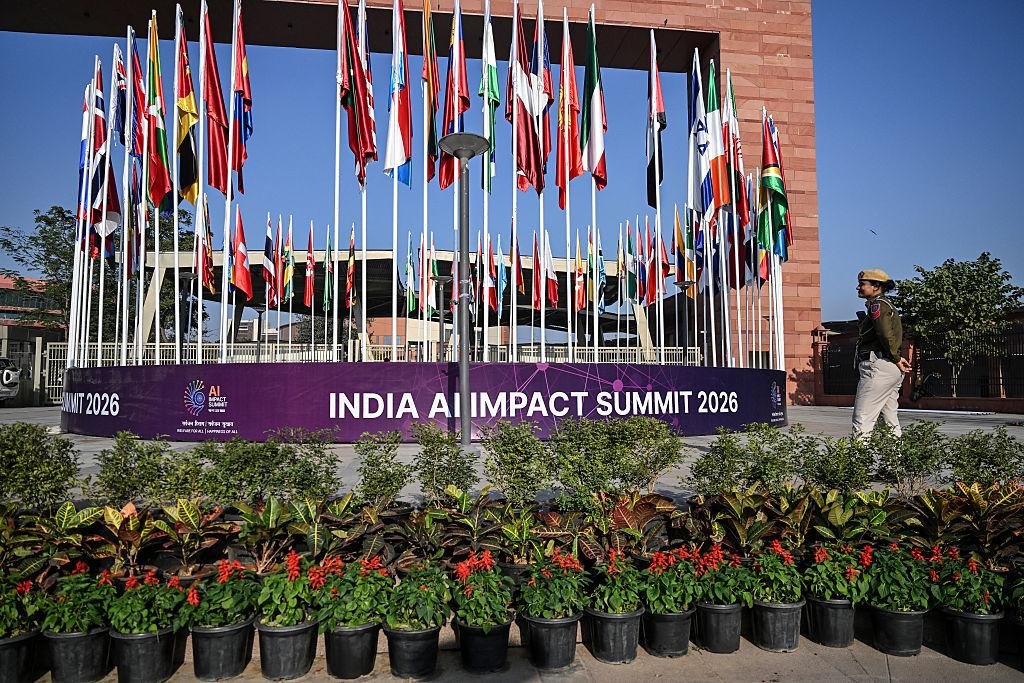
The India AI Impact Summit 2026 in New Delhi marked a historic moment for the global AI ecosystem. Hosted at Bharat Mandapam, this summit brought together policymakers, tech leaders, researchers, and innovators from across the world. It positioned India as a key player in shaping the future of AI.
The summit took place from 16 to 20 February 2026 and was organized under the Government of India’s IndiaAI Mission.
Over 100 countries
Global tech giants and CEOs
Policymakers, researchers, and startups
Chakras: Key Themes Driving Global AI Collaboration
High-Level Global Participation at AI Summit 2026
The India AI Impact Summit 2026 has attracted significant high-level engagement, with participation from 15–20 Heads of Government, over 50 international ministers, and more than 40 global and Indian CEOs. This strong presence clearly reflects the global importance of the summit and highlights India’s growing influence in the field of artificial intelligence. Moreover, it demonstrates how world leaders and industry experts are coming together to collectively shape the future of AI on a global scale.
Structure of Chakras and Working Groups
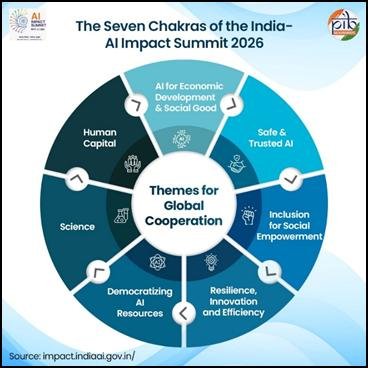
The summit’s deliberations are organized through Chakras, or Working Groups, which are structured around seven interconnected thematic areas. Each Chakra focuses on a core aspect of AI impact and translates key ideas into actionable policies and real-world applications. In addition, over 100 countries have actively engaged in these Working Groups, contributing to the development of responsible, inclusive, and globally relevant AI systems.
Human Capital and Social Inclusion Focus
Each Chakra promotes multilateral collaboration on the societal impact of AI, addressing critical areas such as skill development, inclusion, transparency, and sustainability. For instance, the Human Capital Chakra focuses on advancing equitable skill development and preparing the workforce for an AI-driven future. Similarly, the Inclusion for Social Empowerment Chakra ensures that AI systems are designed to be inclusive, empowering diverse communities and promoting fair representation.
Safe, Trusted AI and Scientific Innovation
Furthermore, the Safe and Trusted AI Chakra emphasizes building globally trusted AI systems based on transparency, accountability, and shared safeguards. At the same time, the Science Chakra aims to accelerate innovation by fostering scientific collaboration and translating breakthroughs into global progress. Meanwhile, the Resilience, Innovation, and Efficiency Chakra focuses on developing sustainable and resource-efficient AI systems that strengthen climate resilience.
Democratizing AI and Economic Growth
Additionally, the Democratizing AI Resources Chakra works toward ensuring equitable access to foundational AI tools and technologies, enabling inclusive innovation worldwide. Likewise, the AI for Economic Development and Social Good Chakra highlights the role of AI in enhancing productivity, driving innovation, and supporting inclusive growth across economies and societies.
India’s Vision for Global AI Leadership
Overall, through these Chakras, India aims to shape global AI norms while addressing both local and global challenges. As a result, the outcomes of the summit are expected to guide policymakers, investors, and industry leaders in the coming years, ensuring that AI development remains responsible, inclusive, and impactful.
Human Capital: India’s Talent Pool Anchoring Global AI Cooperation
AI offers India a powerful pathway to expand social inclusion by improving access to services and participation for communities across languages, regions, and abilities. India’s digital public infrastructure positions it well to translate AI innovations into tangible social outcomes. The Inclusion for Social Empowerment thematic working group focuses on advancing inclusive-by-design AI solutions that reflect India’s diversity, strengthen institutional readiness, and ensure AI systems remain safe, relevant, and usable, with clear benefits for underserved and vulnerable communities.
Flagship Initiatives Enabling Social Empowerment through AI
AI offers India a powerful pathway to expand social inclusion by improving access to services and participation for communities across languages, regions, and abilities. India’s digital public infrastructure positions it well to translate AI innovations into tangible social outcomes. The Inclusion for Social Empowerment thematic working group focuses on advancing inclusive-by-design AI solutions that reflect India’s diversity, strengthen institutional readiness, and ensure AI systems remain safe, relevant, and usable, with clear benefits for underserved and vulnerable communities.
Flagship Initiatives Enabling Social Empowerment through AI
- Global HealthAI Engagement: India is engaging with HealthAI, the global platform for safe and ethical use of AI in healthcare, strengthening responsible innovation and adoption of global best practices.
- BHASHINI: The BHASHINI platform enables inclusive and a voice-first digital governance, supporting over 36 text languages, 22 voice languages, and 350+ AI language models, expanding social inclusion across regions.
- AI-Enabled Farmer Service Delivery: ‘Kisan e-Mitra’ is a voice-based AI chatbot that enables farmers to access PM-Kisan Samman Nidhi services in 11 regional languages. It handles over 20,000 queries daily and has responded to more than 95 lakh queries so far, supporting accessible AI-driven service delivery.
- AI for Informal Workforce Inclusion: NITI Aayog’s report AI for Inclusive Societal Development (October 2025) underscores AI’s potential to empower India’s 490 million informal workers by widening access to various services.
By integrating inclusive design into digital public infrastructure, AI systems are improving access to services across languages and regions, reinforcing trust and social empowerment as core outcomes of India’s AI governance journey.
Safe and Trusted AI: Enabling Responsible AI Aligned with National Priorities
As AI systems grow in scale and impact, ensuring reliability, transparency, and accountability becomes central to sustaining public confidence and responsible innovation. India’s regulatory frameworks position it to contribute meaningfully to the global AI safety efforts. The Safe and Trusted AI thematic working group focuses on strengthening governance capacity and enabling shared learning across countries.
India’s Efforts for Developing Safe and Accountable AI
- Responsible AI Project Portfolio: Under the Safe and Trusted AI pillar, 13 projects have been selected through Expressions of Interest to develop responsible AI tools focused on safety, bias mitigation, transparency, and accountability.
- Mission Digital ShramSetu: NITI Aayog proposed Mission Digital ShramSetu to create an ecosystem that will make AI accessible and affordable for all, harnessing AI and emerging technologies to empower informal workers.
- IndiaAI Safety Institute: India is establishing the IndiaAI Safety Institute under the Safe and Trusted Pillar of the IndiaAI Mission to address AI risks & Safety Challenges.
AI Governance Guidelines
India’s AI Governance Guidelines align AI adoption with national development goals ahead of the India AI Impact Summit 2026. To apply these principles into practice, the guidelines propose a structured governance framework.
- Establish an AI Governance Group (AIGG) to coordinate overall policy development and align AI governance with national priorities.
- Constitute a Technology and Policy Expert Committee (TPEC) to provide expert inputs on national and international AI governance issues.
- Provide adequate resources to the IndiaAI Safety Institute (AISI) to undertake research, draft standards, develop testing methods and benchmarks, collaborate with international and national standard bodies, and provide technical guidance to regulators and industry.
India is building a balanced AI ecosystem where innovation moves with responsibility. The Safe and Trusted AI Chakra reinforces national priorities of inclusion, growth and digital sovereignty.
Science: AI-Enabled Scientific Research in India
As research becomes more data-intensive and collaborative, there is a strong opportunity to broaden participation and improve the translation of scientific research into real-world solutions in areas such as health, agriculture, and climate. With its growing research base, digital infrastructure, and commitment to open science, India is well positioned to contribute to a more equitable global research ecosystem. The Science thematic working group focuses on advancing open and transparent AI-enabled research and collaborative frameworks that widen participation across regions and institutions.
Progress in India’s Collaborative AI Science
- Innovation Footprint: India is the 6th largest patent filer globally, and its Global Innovation Index rank has improved from 81 to 38, reflecting stronger scientific research translation.
- Boost in R&D Investment: National expenditure on research and development increased from ₹60,196 crore in 2010–11 to ₹1.27 lakh crore in 2020–21, reflecting sustained expansion of India’s scientific research ecosystem.
- ANRF AI-Enabled Research: The Anusandhan National Research Foundation (ANRF) targets ₹50,000 crore in research funding during 2023–2028 to strengthen national research capacity.
- IMD Hybrid AI Forecasting: India Meteorological Department is using hybrid AI models for rainfall, lightning, fog, and fire prediction, along with MausamGPT as a climate advisor for farmers, accelerating AI-enabled scientific forecasting advancements.
- STELLAR Tool: Central Electricity Authority’s STELLAR tool is an indigenously developed resource adequacy model launched in April 2025. It aids DISCOMs in generation-transmission-storage planning with demand response, advancing AI-enabled scientific research for energy security.
These initiatives strengthen India’s role in collaborative, open AI science, fostering global equitable progress.
Democratising AI Resources: Developing Shared AI Resources
Development of AI systems depends on access to compute, data, and infrastructure, resources that remain unevenly distributed across countries and institutions. Open and interoperable infrastructure, combined with multilateral cooperation, can support contextualised AI development aligned with national priorities. The Democratising AI Resources thematic working group focuses on advancing equitable access and strengthening global representativeness.
Key Milestones in Shared AI Infrastructure
- Sovereign AI Compute: Under the IndiaAI Mission, a secure GPU cluster is being constructed to house 3,000 next-generation GPUs for sovereign and strategic applications.
- IndiaAI Kosh (AIKosh): The platform has over 7,400 datasets and 273 AI models across 20 sectors, enabling researchers and startups to access high-quality, India-centric data for AI innovation.
- AI Data Labs Network: India is launching AI Data Labs to build grassroots AI skills in Tier-2 and Tier-3 cities through training in data annotation and curation, forming a nationwide network of 570 labs.
- National Supercomputing Mission (NSM): The flagship mission has deployed over 40 petaflops machines across IITs, IISERs, and research labs, forming a distributed high-performance computing base for academia.
- AIRAWAT: India’s premier AI supercomputer, launched by MeitY in 2023 and integrated with PARAM Siddhi-AI, delivering shared compute for advanced AI research.
- Compute Access: The IndiaAI Compute Portal democratizes access to over 38,000 GPUs and 1,050 TPUs, empowering large-scale AI model development to address economic challenges and societal needs.
- Inclusive Pricing Edge: Access to compute is available at subsidised rates of under Rs. 100/hour, compared to the global rates of more than Rs. 200/ hour.
These efforts anchor India’s vision for open, accessible AI infrastructure, driving equitable innovation and global collaboration.
AI for Economic Growth and Social Good: Scaling Impact through AI
While AI holds immense potential to accelerate economic growth and social progress, realizing this promise at scale remains a challenge. The AI for Economic Growth and Social Good Working Group focuses on scaling AI solutions that deliver measurable economic and social outcomes.
Empowering AI-Driven Economic and Social Impact
While AI holds immense potential to accelerate economic growth and social progress, realizing this promise at scale remains a challenge. The AI for Economic Growth and Social Good Working Group focuses on scaling AI solutions that deliver measurable economic and social outcomes.
Empowering AI-Driven Economic and Social Impact
- Agriculture: In agriculture, AI-powered advisory tools are improving sowing decisions, crop yields, and input efficiency, with select state-level deployments such as Andhra Pradesh and Maharashtra, reporting productivity gains of up to 30–50%.
- Healthcare: In healthcare, AI applications are enabling early detection of tuberculosis, cancer, neurological disorders, and other conditions, strengthening preventive and diagnostic care.
- Education: In education, National Education Policy 2020 integrates AI learning through CBSE curricula, DIKSHA platforms, and initiatives such as YUVAi, equipping students with practical AI skills.
- Justice delivery: E-Courts Phase III deploys AI and ML for translation, case management, and citizen-facing services, improving efficiency and transparency through vernacular access.
- Sector Revenue Surge: India’s AI-powered technology sector is projected to generate revenues of around US$ 280 billion in 2025, fuelling robust economic expansion amid surging digital demand.
- Startup Ecosystem: India hosts about 1.8 lakh startups and nearly 89% of the new startups launched in 2024 used AI in their products or services, showcasing widespread ecosystem adoption that spurs innovation and job creation for social upliftment.
Together, the Seven Chakras create pathways for India`s responsible innovation, wider participation, and measurable impact. By aligning policy, technology, governance, and capacity-building, they provide a structured framework to translate shared principles into actionable outcomes across countries and sectors.
Key Highlights of India AI Impact Summit 2026
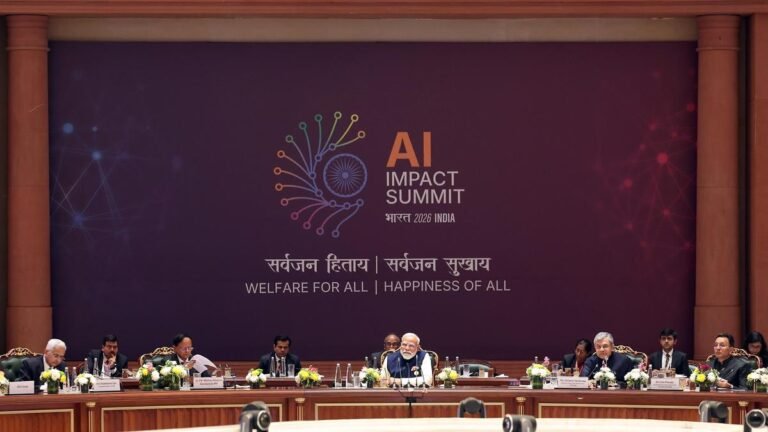
Participation from 100+ countries
Firstly, this made the India AI Impact Summit 2026 a truly global event, bringing together diverse perspectives from across the world. Moreover, leaders, policymakers, researchers, and tech experts collaborated to discuss the future of artificial intelligence and its role in solving global challenges. As a result, this wide international presence highlighted India’s growing influence in the AI ecosystem and its ability to host large-scale, impactful global technology events.
The presence of 300+ AI startups and exhibitors
Additionally, this added strong innovation value to the summit, showcasing cutting-edge technologies and real-world applications of AI. Furthermore, startups presented solutions across industries such as healthcare, agriculture, education, climate change, and smart governance. Not only this, but also it created networking opportunities and encouraged investment, collaboration, and growth in the AI startup ecosystem.
AI for All initiative
Importantly, a major focus of the summit was the AI for All initiative, which aims to make artificial intelligence accessible, affordable, and beneficial for every section of society. In addition, the discussions emphasized bridging the digital divide and ensuring that developing countries can also leverage AI for growth. Therefore, this initiative reflects a vision where AI is not limited to big corporations but reaches grassroots levels to improve everyday lives.
Launch of global AI governance discussions
Meanwhile, the launch of global AI governance discussions was another key highlight, where international leaders addressed the need for clear policies and regulations around AI usage. For instance, topics such as data privacy, algorithm transparency, and responsible AI deployment were widely discussed. Consequently, these conversations are crucial to ensure that AI technologies are used ethically and do not create unintended risks for society.
Strong push for ethical AI frameworks
Finally, there was also a strong push for ethical AI frameworks, focusing on building systems that are fair, unbiased, and accountable. Moreover, experts highlighted the importance of creating AI that respects human rights and maintains trust among users. Overall, this emphasis on ethics ensures that as AI continues to evolve, it remains aligned with societal values and contributes positively to global development.
The story so far:The AI Impact Summit from February 16-20 attracted lakhs of visitors, with high-profile AI executives and heads of state visiting New Delhi. On Saturday (February 21, 2026), 88 countries and international organisations signed the New Delhi Declaration on AI, which stresses that the technology must be democratised to make a difference.
Since 2023, dozens of countries have participated in annual gatherings to discuss AI. In its first instalment in Bletchley Park, the U.K. hosted a small dialogue on safety, where India was represented by then Minister of State for Electronics and Information Technology Rajeev Chandrasekhar. There is no international organisation that convenes these gatherings as of now — participating countries have generally passed on the baton for the following year’s summit.
2024’s edition was held in Seoul, and the last AI Action Summit was held in Paris in February 2025, with Prime Minister Narendra Modi co-chairing the edition with President Emmanuel Macron. In the Paris summit, the multilateral AI dialogue saw a significant shift, with U.S. Vice-President J.D. Vance vocally rejecting a safety-first approach, instead emphasising innovation and unrestrained investment into frontier research and commercialisation of the technology.
AI Summit 2026: Data & Insights
Here are some key data insights from the summit:
-
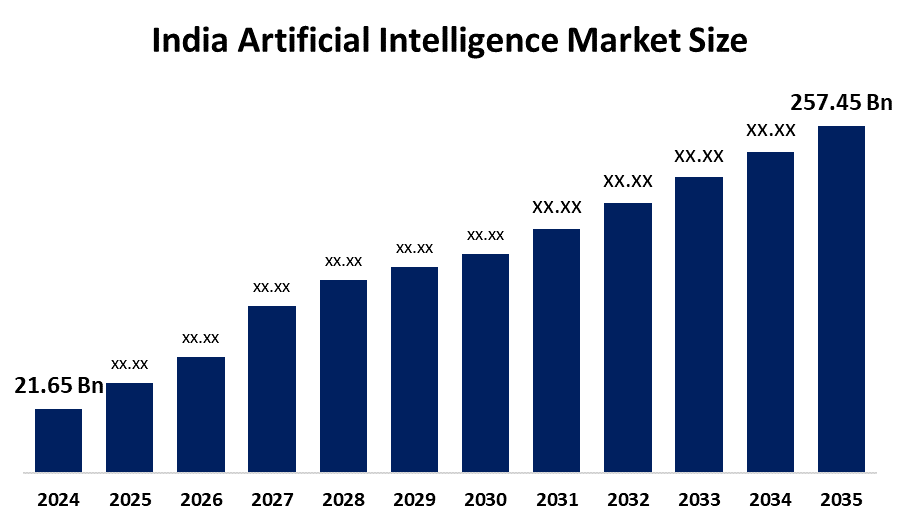
AI market in India expected to reach $17 billion by 2027
-
Over 40% businesses planning AI integration
-
AI could contribute $500 billion to India’s economy by 2030
-
Massive rise in AI-based startups post-2024
For more detailed global AI insights, visit: https://www.worldbank.org/en/topic/digitaldevelopment
🔥 Don’t miss out on the future of technology. Bookmark this blog and stay ahead in the AI revolution.
Conclusion
The India AI Impact Summit 2026 in New Delhi marked a significant milestone in the global journey of artificial intelligence. Overall, it successfully brought together innovation, policy, and collaboration on one platform. Moreover, the summit highlighted India’s growing leadership in the AI space. From global participation to startup innovation, every aspect reflected strong progress. In addition, the focus on ethical discussions showed a responsible approach toward technology. Therefore, the event clearly demonstrated how AI can shape a better and more inclusive future.
As AI continues to evolve, the outcomes of this summit will play a crucial role in defining its direction. Furthermore, the emphasis on inclusivity, governance, and ethical frameworks ensures balanced development. At the same time, global partnerships will accelerate innovation and growth. As a result, India is now strongly positioned to lead the next phase of the AI revolution. In conclusion, the summit has set a clear foundation for a smarter and more responsible AI-driven future.